what is a balanced approach to teaching reading
4 Reasons to Use the Balanced Literacy Approach
Past Instructor and Guest Blogger Amanda Richardson

Why Choose Counterbalanced Literacy
When it comes to instruction reading and writing, there are dissimilar approaches on the spectrum. On i finish, there is a whole language approach and on the other, there is a phonics approach. Education reading with a balanced literacy approach is the perfect combination between whole language and phonics. In a balanced literacy program, students encounter reading and writing modeled, share in the reading and writing with the teacher, are coached, practice independently, and are actively engaged in give-and-take study. Here are 4 reasons to select the counterbalanced literacy approach:
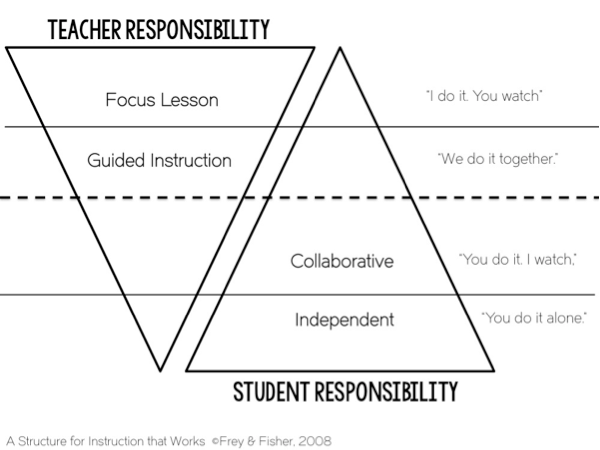
1. It follows a gradual release of responsibility model
As teachers who want to encounter our students succeed, nosotros detect ourselves not providing enough scaffolding or providing besides much scaffolding for their learning. When we follow a gradual release model as shown below, nosotros are able to model what expert readers and writers practice, share in authentic experiences with the students every bit they practise the skills, and then release them to implement the skills independently so that they may become successful. The gradual release model "emphasizes educational activity that mentors students into becoming capable thinkers and learners when handling the tasks with which they have non yet developed expertise" (Buehl, 2005).
2. It's the best of both worlds
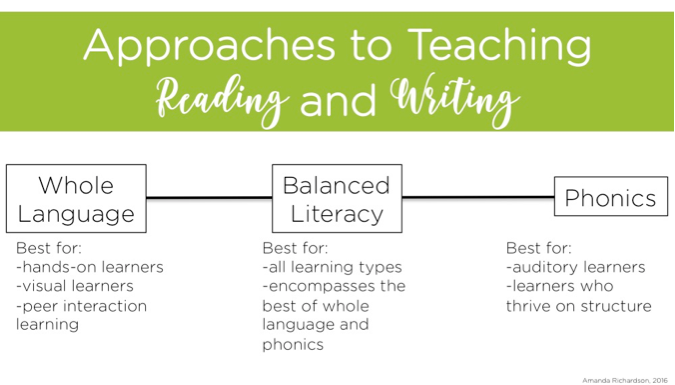
Balanced Literacy sits right in the middle of both the whole language arroyo and the phonics approach. With whole linguistic communication, the conventionalities is that we learn to read and write all-time past engaging in the language undivided. Language is taught through a arrangement that encompasses word recognition and their relation to one another in context. This arroyo works for many students, specifically those that are hands-on, visual, and learn all-time through interaction. But non all students learn this way. With the phonics approach, the conventionalities is that students learn to read best by teaching letter and sound relationships. This is slap-up for the auditory learner. They also love the phonological organization of the language. In balanced literacy, you lot have the best of both worlds. The teacher is able to provide whole linguistic communication learning opportunities through interactive read-alouds, shared reading, interactive writing, and shared writing, while as well providing explicit phonics instruction during both word study and guided reading fourth dimension. Students can exist exposed to both approaches within a balanced literacy classroom.
3. It doesn't forcefulness the teacher to "fit information technology all in"
Often teachers hear guided reading and think that is their approach to teaching reading, but it is not. It is one slice of the puzzle. Inside balanced literacy there are many components that help teach reading and writing. Never practice you take to fit everything in 1 lesson. The day is structured so that there are many opportunities to teach and do reading and writing.
4. It allows the instructor to differentiate learning
As educators, we are learning more than and more each year nearly how to better meet our students' needs. We know for sure that in order for our students to be successful, they must be taught in a way that is mindful of their readiness, their interests, and their learning style. We exercise this by differentiating our educational activity. This can seem like an overwhelming task, but it truly isn't inside a balanced literacy model. The teacher is able to easily differentiate learning during guided reading, literacy stations, give-and-take study, independent reading and writing. It allows the instructor to run into students where they are.
Using the counterbalanced literacy approach to teaching reading has made an immense difference in learning for my students. They are more than engaged, excited about all of the reading and writing happening in our classroom, and they are successful in displaying growth!
Source: Buehl, D, "Scaffolding," Reading Room, 2005, <www.weac.org/News/2005-06/sept05/ readingroomoct05.htm> (November xi, 2006).
Amanda is a Kindergarten and 1st Grade instructor of 6 years. She loves crafting engaging, interactive lessons for students and finds joy in helping other educators by leading them in professional development and journeying alongside. Her love for the classroom is undeniable every bit she shares experiences, tips, and helpful information as she connects with educators on the popular blog, Mrs. Richardson's Class.
You can view the McGraw-Hill Education Privacy Policy hither: http://www.mheducation.com/privacy.html . The views and opinions expressed in this blog are those of the writer, and practice not reverberate the values or positioning of McGraw-Hill Education or its sales.
jonesgribetwouter.blogspot.com
Source: https://medium.com/inspired-ideas-prek-12/4-reasons-to-use-the-balanced-literacy-approach-4e6556ccb19a
0 Response to "what is a balanced approach to teaching reading"
Post a Comment