going forward to what degree will walmart be required to adapt its business model in india

1. What are the biggest obstacles facing Walmart and other

one. What are the biggest obstacles facing Walmart and other foreign retailers in India?
2. Summarize some of the elements in India€™s political, economic, and cultural environments that tin can affect the market opportunity there.
3. Review Figure 12-4. Which quadrant of the matrix applies most directly to Bharat? Why?
4. Going forward, to what degree will Walmart exist required to adapt its business model in Republic of india?

Figure 12-4

Culturally close Chain acquisition Organic Difficult Easy to enter to enter Joint venture, licensing Franchise Culturall

Global retailers that have set their sights on India face special challenges. Equally noted previously in this affiliate, the term organized retail is used to describe activeness by big branded retail chains such every bit Woolworths, Tesco, and Walmart. Such stores currently account for only a minor percentage of India€™s nearly $500 billion in almanac retail sales.
The vast majority of Indian retail activity is conducted in cramped stalls with about 50 square feet of flooring space. There take been many calls for regulatory reform, and some observers believe organized retailing will grow at a rate of 30 to 35 pct in the adjacent few years. For now, nevertheless, some members of the ruling National Congress Party are concerned nearly the impact of organized retail on the millions of small-scale, €œmom-and-pop€ stores.
Modernization of the sector is inevitable, although it has been slow in coming. Until the law was changed in 2012, Walmart and other global retailers that sell multiple brands were barred from participating directly in the Indian market. In 2006, Bharti Enterprises, a local business organisation group that operates India€™southward largest cellular network, announced a articulation venture partnership with Walmart. However, because of restrictions in place at the fourth dimension, the venture consisted of wholesale stores. When single-brand retailers such as Benetton, Nike, Pizza Hut, Reebok, and Subway start came to India, they were required to use franchising equally a market-entry strategy.
The recent regulatory changes will make it easier for such companies to have a majority stake in Indian operations. However, there are strings attached: The authorities has demanded that foreign retailers invest $100 one thousand thousand in India, with at least half the money going to then-chosen €œback end€ operations and infrastructure including cold storage facilities and transportation infrastructure. For its part, the government has pledged more than $iv billion in infrastructure improvements between at present and 2018. In addition, each of India€™s 28 states retains the right to approve or ban foreign-endemic stores.

Western retailers often have to piece of work with local vendors to help them improve their quality. For case, as the Bharti-Walmart venture opened its wholesale greenbacks-and-carry supercenters that serve small retailers, it had to debate with India€™due south poor infrastructure and inefficient supply bondage, which stalk from producers using outdated techniques. Produce is typically transported on open up trucks, horsedrawn carts, and tractors to wholesale markets in big cities. At that place, it passes through the hands of traders and agents licensed by the Agriculture Produce Marketing Committee. It is then transferred to smaller markets or warehouses that are not temperature-controlled. By the time it gets to consumers, the produce has passed through as many as seven intermediaries; much of it is spoiled. In fact, according to regime estimates, one-third of the country€™s produce€"worth $10 billion€"spoils each year.

In India, Walmart must do much more than than just set wholesale and retail stores. It is trying to tranform Republic of india€™south agriculture sector by using its hyperefficient practices to better productivity and speed the menstruum of produce and other appurtenances. Walmart and a partner, Bayer Cropscience, piece of work with farmers to amend yields and quality. In addition, Walmart has begun bypassing traditional middlemen by signing upwardly farmers and sending its own refrigerated trucks to the farms. One reason farmers like working with Walmart: The global behemothic pays the farmers promptly.

Partnership
A legal form of business functioning betwixt ii or more individuals who share management and profits. A Written understanding betwixt two or more individuals who join every bit partners to form and conduct on a for-profit business. Amidst other things, information technology states...

1. What are the biggest obstacles facing Walmart and other

1. What are the biggest obstacles facing Walmart and other strange retailers in India?
2. Summarize some of the elements in India€™due south political, economical, and cultural environments that can affect the marketplace opportunity there.
three. Review Effigy 12-four. Which quadrant of the matrix applies most directly to India? Why?
4. Going forward, to what degree will Walmart exist required to conform its business concern model in India?

Figure 12-4
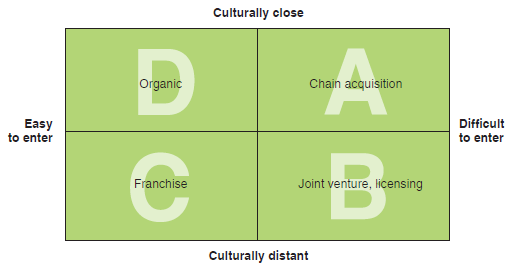
Culturally close Chain acquisition Organic Difficult Easy to enter to enter Joint venture, licensing Franchise Culturall

Global retailers that have set their sights on Bharat face special challenges. As noted previously in this affiliate, the term organized retail is used to describe activity by large branded retail chains such equally Woolworths, Tesco, and Walmart. Such stores currently account for only a small per centum of Bharat€™s nearly $500 billion in annual retail sales.
The vast majority of Indian retail action is conducted in cramped stalls with almost 50 square feet of floor space. There have been many calls for regulatory reform, and some observers believe organized retailing will grow at a rate of 30 to 35 percent in the next few years. For now, withal, some members of the ruling National Congress Political party are concerned well-nigh the impact of organized retail on the millions of minor, €œmom-and-pop€ stores.
Modernization of the sector is inevitable, although information technology has been slow in coming. Until the police force was changed in 2012, Walmart and other global retailers that sell multiple brands were barred from participating straight in the Indian market place. In 2006, Bharti Enterprises, a local business group that operates Bharat€™s largest cellular network, announced a joint venture partnership with Walmart. Still, because of restrictions in place at the time, the venture consisted of wholesale stores. When single-brand retailers such as Benetton, Nike, Pizza Hut, Reebok, and Subway kickoff came to India, they were required to employ franchising as a market-entry strategy.
The contempo regulatory changes will make it easier for such companies to have a bulk stake in Indian operations. However, there are strings fastened: The government has demanded that foreign retailers invest $100 million in Bharat, with at to the lowest degree one-half the money going to and so-chosen €œback end€ operations and infrastructure including cold storage facilities and transportation infrastructure. For its part, the government has pledged more than $4 billion in infrastructure improvements between at present and 2018. In addition, each of India€™south 28 states retains the right to approve or ban foreign-endemic stores.

Western retailers often take to work with local vendors to help them improve their quality. For instance, as the Bharti-Walmart venture opened its wholesale cash-and-bear supercenters that serve small retailers, it had to contend with India€™s poor infrastructure and inefficient supply bondage, which stalk from producers using outdated techniques. Produce is typically transported on open trucks, horsedrawn carts, and tractors to wholesale markets in big cities. There, it passes through the easily of traders and agents licensed by the Agriculture Produce Marketing Committee. It is then transferred to smaller markets or warehouses that are non temperature-controlled. By the time it gets to consumers, the produce has passed through as many as seven intermediaries; much of information technology is spoiled. In fact, according to government estimates, ane-third of the country€™southward produce€"worth $10 billion€"spoils each year.

In India, Walmart must do much more than than just fix wholesale and retail stores. It is trying to tranform Republic of india€™s agriculture sector by using its hyperefficient practices to improve productivity and speed the flow of produce and other appurtenances. Walmart and a partner, Bayer Cropscience, work with farmers to better yields and quality. In addition, Walmart has begun bypassing traditional middlemen by signing upward farmers and sending its own refrigerated trucks to the farms. One reason farmers like working with Walmart: The global behemothic pays the farmers promptly.

jonesgribetwouter.blogspot.com

Source: https://www.solutioninn.com/study-help/foundations-of-marketing/1-what-are-the-biggest-obstacles-facing-walmart-and-other

0 Response to "going forward to what degree will walmart be required to adapt its business model in india"

Post a Comment

Iklan Atas Artikel

Iklan Tengah Artikel 1

Iklan Tengah Artikel 2

Iklan Bawah Artikel